The selection of on-site concrete production equipment is a decisive factor influencing project cost, schedule, and logistical complexity. Two distinct technologies often occupy the same consideration set: the small portable batch plant and the large self-loading mixer. While both offer a departure from traditional ready-mix supply, they embody fundamentally different operational philosophies and capability envelopes. Framing this as a simple face-off is a mischaracterization; it is a strategic selection process dictated by project parameters. A portable concrete batch plant is a scaled-down, decentralized version of industrial concrete production, whereas a self-loading mixer is an integrated material handler and mixer. The optimal choice is not a matter of superior technology, but of alignment with specific volumetric demand, material logistics, and quality imperatives.
The core distinction lies in their foundational design logic. A small portable batch plant operates on the principle of centralized batching with distributed delivery. It is a fixed-point production node, however mobile its chassis. Aggregate and cement are delivered to the plant, which then precisely batches and mixes concrete, typically discharging into transit mixers or dump trucks for short-haul delivery to multiple pour locations within a site. Its strength is systematic production control. It features dedicated aggregate bins, cement silos, and computerized batching systems that ensure rigorous adherence to mix designs. It is engineered for repetition and consistency, producing a continuous stream of specification-grade concrete.
In stark contrast, the large self-loading mixer is a paradigm of autonomous agility. It combines a front-end loader, aggregate hopper, cement compartment, water tank, and mixing drum on a single vehicular chassis. Its operational mode is episodic and self-contained. It drives to a stockpile, loads its own raw materials, mixes while in transit, and discharges directly at the point of placement. Its defining advantage is radical logistical independence. It requires no supporting fleet of loaders or delivery trucks and can operate in locations where establishing even a small batch plant is impractical. However, this autonomy comes at the expense of batch-to-batch precision and volumetric throughput.
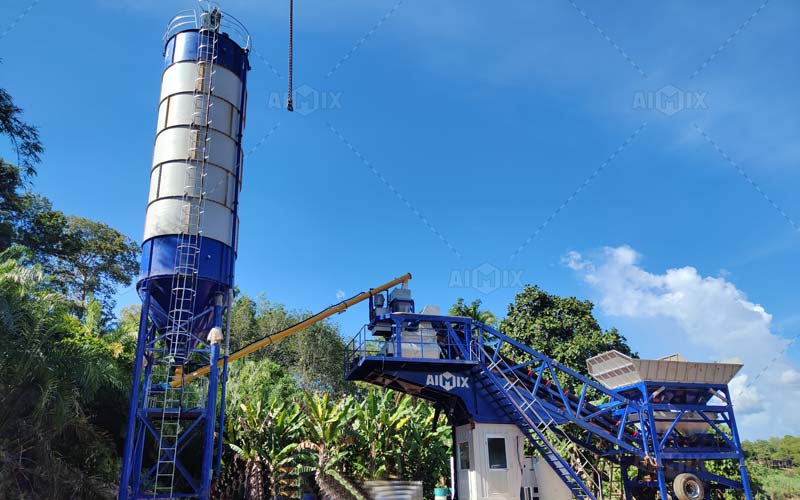
Discerning the correct application for each machine requires a dispassionate analysis of three pillars: output capacity, quality assurance, and comprehensive economics.
Throughput is the first major divergence. A small portable batch plant, such as a 30-50 cubic meter per hour model, is designed for sustained production. It can efficiently supply a small housing development, a commercial slab, or a series of infrastructure footings over days or weeks. Its production cadence is steady and scalable. A large self loading cement mixer, despite its size, is constrained by its cyclic, sequential operation—loading, mixing, discharging, and relocating. Its effective output rarely exceeds 10-15 cubic meters per hour in optimal conditions. It is engineered for a series of discrete, small-volume pours. Deploying it on a project requiring 50 cubic meters in a day is an exercise in inefficiency, while using a batch plant for ten scattered fence post footings is capital overkill.
The precision of the final product is the second fault line. The portable batch plant's computerized system allows for exact control over water-cement ratio, aggregate gradation, and admixture dosage. This is non-negotiable for structural concrete, where compressive strength and durability are paramount. Every batch is a repeatable, documented event. The self-loading mixer relies on volumetric proportioning via bucket loads. This method, while improving over older manual techniques, lacks the fine calibration necessary for high-specification mixes. Moisture content in aggregates is not automatically compensated for, risking significant deviations in slump and strength. Its domain is non-structural applications like lean concrete bases, mass fill, or low-grade blinding concrete where absolute precision is less critical.
The financial analysis must extend far beyond initial purchase or rental price. For the portable batch plant, costs include the plant itself, a dedicated loader for feeding aggregates, and a system for delivering cement (either a bulk tanker or silo). It requires a prepared, stable site with adequate space for material stockpiles and truck maneuvering. Its economic justification is a lower cost per cubic meter over a sufficient volume, amortizing its higher setup complexity. The self-loading mixer presents a simpler direct cost model: one machine, one operator. Its justification is rooted in eliminating ancillary equipment and the overhead of site establishment. Its economic advantage is greatest where material sources are on-site, project sites are multiple and dispersed, or access precludes other equipment. The total cost of operation favors the batch plant on volume, and the self-loader on access and mobilization simplicity.
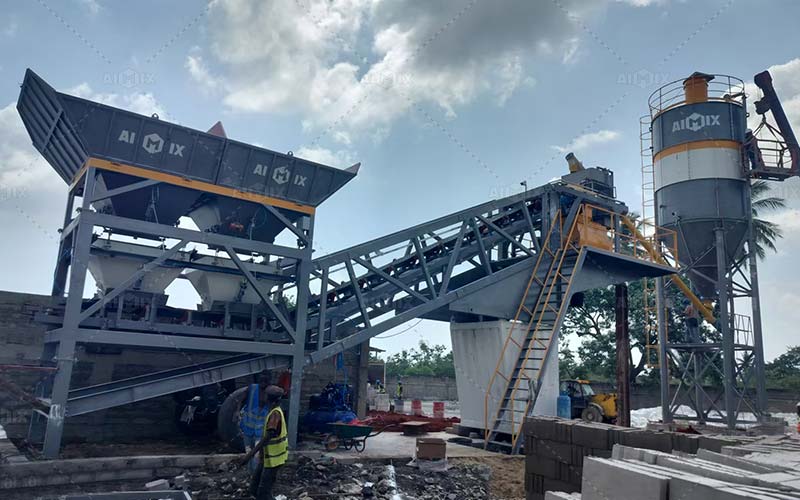
The conclusion is not which machine is better, but which is appropriate. The decision matrix is defined by project characteristics.
This machine is the strategic choice for projects with a defined, concentrated demand for quality concrete. This includes small to medium-scale building projects, remote industrial or energy sites where ready-mix is unavailable, and contractors specializing in concrete production for a local cluster of small jobs. The small concrete plant for sale is selected when specification compliance and consistent output are the primary drivers, and the site can accommodate a semi-permanent production setup for the project's duration.
This machine finds its purpose in scenarios of extreme logistical fragmentation. Its ideal missions are rural road maintenance (culvert placements, small repairs), geographically dispersed agricultural or fencing projects, and disaster recovery or military engineering where infrastructure is nonexistent. It is the tool for autonomous operation in unstructured environments where the primary challenge is access, not volume. It is also a viable option for large sites producing their own low-specification fill material from on-site borrow pits.
Therefore, the face-off resolves into a question of project taxonomy. For structured, volume-driven production of engineered concrete, the portable batch plant is the authoritative solution. For agile, access-driven placement of utilitarian mixes, the self-loading mixer is unparalleled. The successful contractor or project manager is the one who can accurately diagnose the project's core logistical and technical DNA, selecting not the most powerful machine, but the most precisely fitted one.